
Fear has a way of making the future feel more certain than it really is. It whispers worst-case scenarios, magnifies what we cannot control, and convinces us that we need every answer before we can take another step. But faith invites us to look somewhere else—to God, especially when the path ahead feels unclear.
For Christians, choosing faith over fear doesn’t mean we never feel anxious or uncertain. It means learning to bring those feelings to God instead of allowing them to direct our lives. Faith Over Fear — A Christian’s Guide to Walking in Peace, Not Panic is about learning to trust God in the middle of uncertainty, surrender what we cannot control, and keep moving forward with confidence in His care.
What “Faith Over Fear” Really Means
For me, faith over fear has never meant that I stop feeling afraid. Fear can show up even when I genuinely trust God. It can come when the future feels uncertain, when a situation is outside my control, or when my mind starts imagining everything that could go wrong.
What changes is what I do with that fear.
Instead of allowing fear to become the voice that directs my decisions, I can bring it to God. Faith reminds me that I do not have to understand everything before I trust Him. You and I can acknowledge what scares us while still choosing to place our confidence in God.
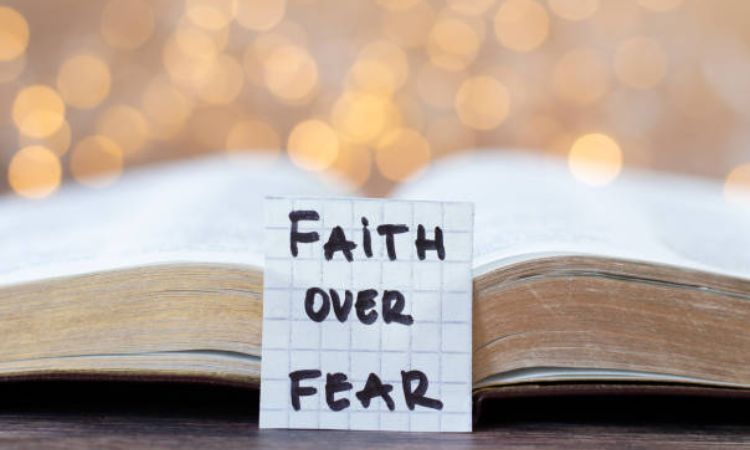
Faith Over Fear Is Not the Absence of Fear
Sometimes we can make faith sound like we should never feel anxious, worried, or afraid. But real faith is much more personal than simply having no difficult emotions.
I can feel fear and still pray.
I can feel uncertain and still trust.
I can have questions and still believe God is present.
That distinction matters, friend, because otherwise we can become discouraged whenever fear returns. We may think, “If I really had faith, I wouldn’t be afraid.” But the presence of fear does not automatically mean the absence of faith.
The more important question is: Where do I turn when fear shows up?
When I’m afraid, I don’t want fear to become the foundation for my choices. I want prayer, God’s promises, and trust in Him to shape how I respond.
That is where Philippians 4:6–7 speaks so directly to everyday life.
Philippians 4:6–7 (NIV):
“Do not be anxious about anything, but in every situation, by prayer and petition, with thanksgiving, present your requests to God. And the peace of God, which transcends all understanding, will guard your hearts and your minds in Christ Jesus.”
Reflection: What fear or concern do I need to bring honestly to God instead of carrying it by myself?
I love how practical this passage is. It doesn’t tell me to pretend that nothing is wrong. It tells me what to do in every situation: pray, make my requests known to God, and give thanks.
That gives me somewhere to put my anxiety.
When I don’t know what tomorrow will bring, I can pray about tomorrow. When I’m worried about something I cannot fix, I can place that concern before God. When my thoughts keep circling around the same problem, I can return to prayer instead of letting anxiety have the final word.
And notice the promise. Paul speaks about the peace of God guarding our hearts and minds in Christ Jesus. That peace can exist even when circumstances haven’t changed yet.
That has been an important reminder for me: sometimes God changes the situation, and sometimes He gives me strength and peace while I’m walking through it.
Faith Means Choosing Where I Place My Trust
Fear naturally wants my attention. It tells me to focus on what could go wrong, what I cannot control, or what might happen next.
Faith redirects my attention toward God.
That doesn’t mean ignoring reality. It means refusing to believe that the frightening thing in front of me is bigger than the God I trust.
This is why faith over fear is ultimately about where I place my trust.
If I place all my confidence in circumstances, I’ll probably feel secure only when everything is going according to plan. But circumstances change quickly. What feels stable today may look completely different tomorrow.
Trusting God gives me a deeper foundation.
Even when I don’t know the outcome, I can choose to believe that I don’t have to face the unknown alone. Even when I cannot see the whole path, I can take the next faithful step.
Faith Is a Daily Practice
One of the biggest things I’ve learned is that faith isn’t simply a decision I make once and never revisit.
I need to practice it.
Some mornings I wake up feeling confident and peaceful. Other days, fear seems to arrive before I’ve even gotten out of bed. On those days, choosing faith may look very ordinary: praying before reacting, slowing down before making a decision, thanking God even when life feels difficult, or simply surrendering a situation I cannot control.
That’s why I think of faith as a daily rhythm.
I don’t have to solve my entire future today.
I can trust God with today.
Then tomorrow, I can do it again.
And when fear comes back, I can return to Him again.
This doesn’t make me weak. It reminds me where my strength and security ultimately come from.
Faith Gives Fear a Different Place in My Life
I don’t want fear to disappear before I start trusting God. I want to learn how to trust God while fear is present.
That changes the way I respond to difficult circumstances.
Instead of immediately assuming the worst, I can pray.
Instead of letting anxious thoughts run endlessly through my mind, I can bring my concerns to God.
Instead of demanding that I know exactly how everything will work out, I can acknowledge that God sees what I cannot.
And instead of measuring God’s faithfulness by whether everything goes exactly the way I want, I can remember that His presence and peace matter even in uncertain seasons.
For you and me, faith over fear doesn’t mean saying, “I’m never scared.”
Sometimes it simply means saying, “I’m scared, but I’m going to trust God with this.”
That’s a very different kind of courage.
And it is a courage I can practice one day, one prayer, and one situation at a time.
7 Biblical Truths to Stand On When Fear Rises
1. God Is Present, Even Now — Isaiah 41:10
One of the most frightening parts of uncertainty is feeling alone in it.
I can handle a difficult situation differently when I know someone trustworthy is beside me. But when I start believing that I have to carry everything by myself, even a manageable problem can suddenly feel overwhelming.
That is why Isaiah 41:10 means so much to me. God directs His people away from fear by reminding them of who He is and of His presence with them.
“So do not fear, for I am with you; do not be dismayed, for I am your God. I will strengthen you and help you; I will uphold you with my righteous right hand.”
— Isaiah 41:10 (NIV)
I notice how many of God’s promises are packed into this one verse.
He says, “I am with you.”
He says, “I am your God.”
He says, “I will strengthen you.”
He says, “I will help you.”
And He says, “I will uphold you.”
When fear tells me, You’re on your own, this verse tells me something completely different.
God is with you.
That does not mean the difficult circumstance automatically disappears. It means the circumstance is not the only reality I need to consider. God’s presence is part of the reality too.
And sometimes that is exactly where faith begins.
I may not know what will happen next. I may not have an answer for every question. I may still feel nervous about what tomorrow brings. But I can stop and remind myself that uncertainty does not mean God’s absence.
I also love that God does not simply say, “Be strong.”
He says, “I will strengthen you.”
That changes the way I think about courage. I do not have to manufacture enough strength inside myself to handle everything perfectly. I can ask God for strength when my own feels depleted.
When I am worried about a decision, I can ask Him for wisdom.
When I am exhausted, I can ask Him for strength.
When I feel overwhelmed, I can ask Him for help.
When I am afraid of what is ahead, I can remember that I am not walking into the unknown alone.
Friend, if fear has been making you feel isolated lately, pause for a moment. Look beyond the problem and remember the Person who is with you in the middle of it.
Reflection: What situation am I facing right now where I need to remind myself, “God is with me”?

2. Perfect Love Casts Out Fear — 1 John 4:18
Fear does not always begin with circumstances.
Sometimes it begins with what I believe about myself.
What if I fail?
What if people reject me?
What if I am not good enough?
What if I disappoint God?
Those fears can become incredibly heavy because they reach deeper than whatever is happening around me. They touch my sense of security and belonging.
That is why the connection between love and fear in 1 John 4:18 is so powerful.
“There is no fear in love. But perfect love drives out fear, because fear has to do with punishment. The one who fears is not made perfect in love.”
— 1 John 4:18 (NIV)
When I read this, I am reminded that God’s love is not something I have to earn by performing perfectly.
The verse specifically connects fear with punishment. John is talking about the kind of fear associated with judgment, while pointing believers toward confidence in God’s love.
That gives me a different way to examine the fears inside my own heart.
Sometimes I need to ask, What am I actually afraid of?
Maybe the surface concern is money, work, relationships, or the future. But underneath it may be a deeper fear of rejection or failure.
Once I recognize that, I can bring the deeper fear to God instead of merely trying to silence the symptoms.
I can remind myself that God’s love does not depend on me having a flawless day.
I can come to Him when I am confused.
I can come when I have failed.
I can come when I feel ashamed.
I can come when I do not know what to do next.
His love gives me a secure place from which to face those things.
This does not mean that I will never experience fear again. I still have moments when my emotions get ahead of my faith. But when that happens, I can return to the truth instead of allowing fear to define my relationship with God.
I do not have to run away from Him because I am afraid.
I can run toward Him.
And the more deeply I rest in God’s love, the less I need to live as though everything depends on my ability to protect myself, perform perfectly, or control every outcome.
Friend, sometimes the most important question is not, How do I get rid of this fear?
It is, What does this fear reveal about what I believe?
Then I can bring that belief to God and allow His truth to reshape it.
Reflection: Is there a fear of rejection, failure, punishment, or not being enough that I need to surrender to God’s love?
3. Peace Is a Gift, Not a Personality Trait — John 14:27
I used to think of peacefulness almost like a personality type.
Some people seem naturally calm. They can face unexpected problems without immediately panicking. Others of us can have a mind that starts running through ten different possibilities before we have even finished processing the first one.
But Jesus gives me a different understanding of peace.
Peace is not merely something I am supposed to manufacture through having the right personality.
Jesus speaks of peace as something He gives.
“Peace I leave with you; my peace I give you. I do not give to you as the world gives. Do not let your hearts be troubled and do not be afraid.”
— John 14:27 (NIV)
What stands out to me is the contrast between Christ’s peace and what the world offers.
The world often tells me I will have peace once the circumstances are right.
Once the money is there.
Once the relationship is fixed.
Once the diagnosis is resolved.
Once the future is secure.
Once I finally know what is going to happen.
But if my peace depends entirely on circumstances, I will always be vulnerable to whatever changes next.
Jesus offers something different.
He says, “my peace I give you.”
That does not mean I should pretend difficult things are not difficult. It means I do not have to wait for everything around me to become calm before I turn toward Him.
Sometimes I pray, Lord, please change this situation.
Other times my prayer becomes, Lord, while I am waiting for this situation to change, please keep my heart anchored in You.
Both prayers matter.
And I think that is one of the most practical lessons here.
I do not have to be naturally peaceful to seek God’s peace.
When my thoughts are racing, I can slow down.
When I am tempted to imagine every possible disaster, I can stop and pray.
When I do not know what tomorrow will bring, I can remind myself that Jesus does not ask me to possess tomorrow’s answers before I can trust Him today.
Peace does not require pretending.
I can say, This is hard.
I can say, I am scared.
I can say, I don’t know what happens next.
And I can still say, Jesus, I trust You with this.
That is a kind of peace I could never manufacture simply by trying harder to feel calm.
Reflection: Am I waiting for my circumstances to become peaceful before I allow myself to receive the peace Jesus offers?
4. Anxiety Can Be Exchanged for Prayer — Philippians 4:6–7
This is one of the most practical passages I can turn to when worry starts taking over my thoughts.
Paul does not tell me to pretend that my concerns do not exist. He tells me what to do with them.
“Do not be anxious about anything, but in every situation, by prayer and petition, with thanksgiving, present your requests to God.”
— Philippians 4:6 (NIV)
And then Paul continues:
“And the peace of God, which transcends all understanding, will guard your hearts and your minds in Christ Jesus.”
— Philippians 4:7 (NIV)
I love how specific this is.
“In every situation.”
Not just the major crises.
Not only the things that seem spiritual enough to bring to God.
Every situation.
That means I can talk to God about the things that are weighing on me today. I can bring Him the decision I cannot make, the conversation I am dreading, the financial concern I cannot solve, the uncertainty that keeps returning to my mind.
Paul gives me three ways to approach God: prayer, petition, and thanksgiving.
Prayer turns my attention toward God.
Petition allows me to tell Him specifically what I need.
Thanksgiving helps me remember God’s goodness instead of allowing my current fear to become the only thing I can see.
That last part can be especially difficult when I am anxious.
When I am worried, my mind wants to collect evidence for everything that could go wrong. Thanksgiving interrupts that cycle by reminding me of what is already true.
I can say:
God, thank You for carrying me this far.
Thank You for the people You have placed in my life.
Thank You for the ways You have helped me before.
Thank You that I can bring this concern to You right now.
Then I can be honest about what I need.
I do not have to dress up my prayer.
I do not need impressive words.
I can simply tell God the truth.
Father, this is what I am afraid of.
This is what I cannot control.
This is what I need.
Please give me wisdom and help me trust You.
And then comes one of the most beautiful promises in the passage: “the peace of God, which transcends all understanding, will guard your hearts and your minds in Christ Jesus.”
Notice that Paul does not promise that I will understand everything.
In fact, the peace he describes goes beyond what human understanding can explain.
Sometimes I want God to give me an explanation before He gives me peace.
But Scripture points me toward something different.
I can have peace even while I am still waiting for answers.
That does not mean every anxious thought disappears instantly. It means I have a practice I can return to whenever anxiety rises: bring it to God, name it honestly, give thanks, and trust Him with what I cannot control.
Friend, the next time your thoughts begin spiraling, try not to carry the entire future in your head.
Take the specific worry that is in front of you and turn it into a prayer.
Then do it again when the worry returns.
That repeated turning toward God is part of learning to live by faith.
Reflection: What specific anxiety can I turn into a direct prayer to God right now?
These four truths give me a foundation for what it means to choose faith over fear. I do not have to wait until fear disappears before I trust God. I can trust Him while fear is still present.
God is with me.
His love is greater than the fear that torments me.
Jesus gives peace that does not depend entirely on circumstances.
And when anxiety rises, I can bring it directly to God in prayer.
That is not pretending to be fearless.
That is learning where to stand when fear comes.
5. God’s Plans Are for Your Good — Jeremiah 29:11
There are seasons when fear is not really about what is happening today. It is about what I think might happen tomorrow.
I can handle what is in front of me, but uncertainty about the future can make my heart restless. I start asking questions I cannot answer: What if this gets worse? What if nothing changes? What if the future I hoped for never happens?
That is where Jeremiah 29:11 has become such an important reminder for me.
“‘For I know the plans I have for you,’ declares the Lord, ‘plans to prosper you and not to harm you, plans to give you hope and a future.’”
— Jeremiah 29:11 (NIV)
I love the fact that God says, “I know.”
I may not know.
You may not know.
We may have absolutely no idea how a difficult chapter will unfold.
But God is not confused about the future.
That does not mean everything I experience will be easy. In fact, the original setting of this promise makes that clear. Jeremiah was speaking to Jewish exiles in Babylon. They were living through a painful period of displacement, and God’s message did not promise that their circumstances would immediately change. The surrounding passage describes a long period of waiting before restoration.
That context changes the way I read this verse.
It is not a promise that says, “If you trust God, you will never experience hardship.”
It is a reminder that hardship does not mean God has abandoned His people.
Sometimes I want God to show me the entire plan before I feel comfortable taking another step. But faith rarely works that way.
Faith often means trusting the One who knows the plan when I can only see the next few feet of the road.
When fear tells me, This is the end of everything good, Jeremiah 29:11 reminds me that I cannot see the whole story from where I am standing.
My present circumstances are real.
My disappointment is real.
My uncertainty is real.
But none of those things gives me permission to assume that God has no future purpose beyond what I can currently see.
That is where hope becomes so important.
Biblical hope is not simply optimism. It is not telling myself that everything will turn out exactly as I want. It is choosing to trust God’s purposes even when I do not yet understand how He is working.
I can still take today’s faithful step.
I can still pray.
I can still love the people God has placed around me.
I can still do the work in front of me.
I can still wait without giving up.
And when I am tempted to believe that my current pain is the final chapter, I can remember that God sees further than I do.
Friend, if you are walking through a season that feels stuck, do not confuse waiting with being forgotten.
You may not understand what God is doing yet.
But you do not have to understand the entire future in order to trust Him today.
Reflection: Have I allowed my current circumstances to convince me that God has no hopeful purpose beyond what I can see right now?

6. You’re Not Given a Spirit of Fear — 2 Timothy 1:7
Fear can become more than an emotion.
If I am not careful, it can become a decision-maker.
Fear tells me when to speak and when to stay silent. It tells me what risks are too dangerous, what opportunities are impossible, and what failures I should avoid at all costs.
Eventually, I can start organizing my entire life around avoiding discomfort.
That is why Paul’s words to Timothy challenge me.
“For the Spirit God gave us does not make us timid, but gives us power, love and self-discipline.”
— 2 Timothy 1:7 (NIV)
This verse does not tell me that I will never feel afraid.
Instead, it reminds me that fear and timidity are not supposed to become the forces that control my life.
Paul was encouraging Timothy to remain faithful and courageous in his calling. The surrounding passage emphasizes holding firmly to the gospel and not being ashamed of testimony about Christ, even when faithfulness involves suffering.
That makes this verse much more practical for me.
Paul is not simply saying, “Try to feel braver.”
He points Timothy toward what God has given him.
Power.
Love.
Self-discipline.
When I am afraid, I need to remember that courage does not necessarily mean feeling confident.
Sometimes courage means doing what is right while my feelings are still telling me to run away.
I might be nervous and still have an important conversation.
I might feel inadequate and still serve someone.
I might not know exactly what will happen and still obey God.
I might feel intimidated and still choose love instead of self-protection.
That is a much more realistic picture of faith than pretending fear never exists.
The word “power” reminds me that I am not limited to whatever strength I happen to feel in a particular moment.
Love reminds me to look beyond myself. Fear naturally turns my attention inward: What will happen to me? What will people think of me? How can I protect myself? Love helps me turn outward again.
And self-discipline reminds me that I do not have to obey every thought that enters my mind.
That last part is especially important.
A fearful thought can feel incredibly convincing without actually being true.
My mind can say:
This will definitely go wrong.
Everyone will reject me.
I cannot handle this.
There is no way forward.
But I do not have to automatically accept every thought fear produces.
I can pause.
I can pray.
I can return to Scripture.
I can ask what is actually true.
Then I can take the next wise and faithful step.
That is what I appreciate about this verse. It moves me away from simply asking, “How can I stop being afraid?”
Instead, I can ask:
How can I live faithfully even while I feel afraid?
That question changes everything.
Because sometimes fear will leave quickly.
Other times, it will take longer.
But I can still choose faithfulness.
Friend, you do not have to wait until you feel fearless before you move forward.
You can be nervous and courageous at the same time.
Reflection: Where has fear been controlling a decision that I need to place back under God’s direction?
7. Casting Your Cares Is an Active Choice — 1 Peter 5:7
Some worries are easy to name.
Others sit in the background of my mind all day.
I can be making breakfast while thinking about money. I can be working while worrying about a relationship. I can be trying to sleep while replaying something that happened earlier.
The problem is not always that I have concerns.
The problem is that I start carrying them as though everything depends on me.
That is why Peter’s instruction feels so personal and practical.
“Cast all your anxiety on him because he cares for you.”
— 1 Peter 5:7 (NIV)
There are two parts of this verse that I do not want to separate.
First: “Cast all your anxiety on him.”
Second: “because he cares for you.”
God does not simply tell me to stop worrying.
He gives me somewhere to take the worry.
That distinction matters.
If someone tells me, “Don’t worry,” without giving me anywhere to put my concerns, I am still left holding them.
Peter gives me a different response.
Give them to God.
And notice the word “all.”
Not just the impressive problems.
Not only the things that other Christians might consider spiritual enough to pray about.
All.
The financial concern.
The family situation.
The uncertain decision.
The conversation I cannot stop replaying.
The future I cannot control.
The fear I feel embarrassed to admit.
I can bring all of it to God.
And I need to remember that “casting” is not passive. It is an intentional response. I have to make the decision to take what I am carrying and place it into God’s hands.
That can require practice.
Sometimes I pray about something and then ten minutes later I start worrying about it again.
I think, Didn’t I just give this to God?
Yes.
But I can give it to Him again.
Prayer is not a one-time transaction where I surrender a concern and am never tempted to pick it back up.
For me, surrender often looks like repetition.
Lord, I’m worried about this again.
I cannot control this.
You already know what I need.
I am putting it back in Your hands.
That is not weakness.
That is learning to trust.
And then there is the reason Peter gives:
“because he cares for you.”
That may be the most comforting part of the entire verse.
God is not asking me to surrender my worries because my problems annoy Him.
He is not distant from what I am experiencing.
He cares.
That means I can come to Him honestly.
I do not have to make my prayer sound impressive.
I do not have to pretend I am stronger than I am.
I can simply tell Him what is hurting, what I fear, what I do not understand, and what I need.
Sometimes I imagine surrender as letting go of a heavy object I have been gripping for too long.
I finally admit, I cannot carry this by myself.
And instead of continuing to squeeze my hands around it, I open them.
That is what casting my cares can look like.
It does not necessarily mean that the situation changes immediately.
It means I stop insisting that I must personally control the outcome.
I do what I can.
I pray about what I cannot do.
And I trust God with the part that belongs to Him.
Friend, if you have been carrying something alone for a long time, you do not have to wait until you have the perfect words.
Start with the burden you are carrying right now.
Name it before God.
Give it to Him.
And remember why you can do that:
He cares for you.
Reflection: What anxiety am I still carrying as though I have to solve it alone?